
Education for this Moment

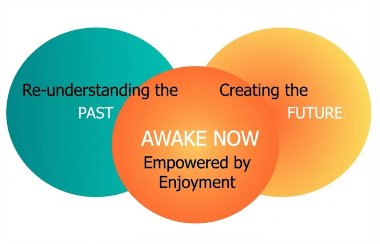
Intelligent Worksheets approaches learning as a living system. Rather than treating education as the delivery of content, it is seen here as participation in complex, interconnected processes involving people, environments, attention, and experience. In this sense, learning is not linear or mechanical — it emerges from relationships within a system.
Waking up to Life opens the door to Enjoyment and Empowerment.
The Power to Enjoy this Moment allows us to begin to make sense of the past and to be free from our past mistakes or negative experiences.
As we discover our power to enjoy and appreciate life, we learn to make the Choices that allow us to Create the Future that we want.

Teachers, curriculum designers and teaching materials writers can never grasp or control the complexity of what is going on at a given moment for even one individual, let alone a class of students. But we can learn to have fun managing it — not by trying to control complexity, but by taking shared responsibility for tending the conditions in which learning can emerge.
The current moment in history calls for an approach to education that allows learners to find and be themselves, and to make their own way through what they choose to learn, at their own pace.
Learning does not primarily arise from instruction, but from participation in experience. In complex learning systems, understanding grows through ongoing interaction between inner awareness and outer conditions. The processes of education — how learners attend, respond, choose, and adapt — are not background mechanisms. They are the curriculum.
The way to understand the inevitably growing importance of AI in education is not to think that teachers will become redundant. Rather, AI is making it possible for us to choose to create an education in which teachers will play a more important and much more enjoyable role than ever before.
This will involve a shift from seeing the role of teachers as primarily explaining and evaluating. Their role needs to move more toward being seen as as fellow learners with their students (learners of the subject at hand and learners of the art of living) and as facilitators of personal growth. To be able to to this, teachers will themselves need to be open to learning and growing.
Intelligent Worksheets aims to embody and clarify the principles needed to facilitate the gradual transition away from an education that grew out of the industrial revolution. This industrial paradigm and its top-down control structures is now crumbling. The seeds of an approach that prioritizes the individual and democratic ideals have long been in the ground. It is an approach that was articulated with brilliant clarity more than one hundred years ago by John Dewey.
He emphasized the importance of engagement in NOW. Education is the "continuous reconstruction of experience." It is a cycle where inner intent acts upon outer conditions: we act, undergo the consequences, reflect on the meaning, and use that new understanding to direct future actions.
Participation is not just "taking part" but is the essence of democratic living. We are co-creating the community (school, for example) that we are a part of and the world as a whole. Control needs to come from our conscious choice to accept the rules of the "game", not from unquestioning compliance with authority outside of ourselves.
The philosophy of Intelligent Worksheets builds on Dewey's principles by clarifying how participation works in practice: learning deepens when inner agency and outer conditions continuously respond to and are recreated by one another through ongoing participation in lived experience — a dynamic that I call:
These are not abstract values. They describe the conditions required for healthy learning systems — environments where people feel able to participate, adapt, and grow within complexity.
Respect for others begins with respect for ourselves.
While change is inevitably going to be rapid, disruptive and painful for many, it needs to be managed with RESPECT, with a clear consciousness that coercion is a tool of the past. RESPECT here means remembering that we are human beings first and our social roles second. I often used to say this to my university students.
I would also often play a small game with them.
I would ask: “Why is this time, from (for example) 9 o’clock to 10:40 on a Wednesday morning, important?”
Because they were "playing the role" of students, they assumed I wanted an answer like, “Because it is Professor Mark’s English class” or “Because it is a chance to use real English.” I would laugh and say, “No, that’s not the answer. The answer is: because this is 100 minutes of my life.” The point was to remind them that this class was not just a slot in the weekly timetable. It was a part of our life itself, a moment in which we are alive at the most dynamic period in human history.
To PROTECT means to strive to safeguard one another from the pressures to pretend or to be dishonest about what we feel. It is easy for children and adults alike to be pushed unconsciously into silence or habitually masking our authentic selves.
As a child, I did not know how to talk honestly about my own experiences of school, experiences that were having a nearly disastrous effect on my life. While my own experiences may have been somewhat extreme, I have seen, throughout my professional and personal life, how the same patterns that troubled me often negatively affect the lives of students, colleagues, friends and family.
To Nurture means to accept people as they are and to listen openly, without judgment and with the knowledge that we are all in process. We can choose to grow from our mistakes or weaknesses. There is no need for anything in the past to define who we are.
True challenge is not coercive or controlling. It is an invitation to grow, to stretch toward possibilities and strength that we might not have seen in ourselves.
Everything in our lives is interconnected. The habit of striving for Excellence in one area of our lives impacts the quality of what we do in other areas.