
teaching experience: Say something in a puzzled tone of voice


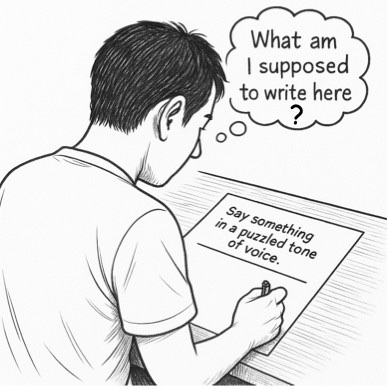
The following story illustrates one way of contrasting the notions of being “asleep" and "awake to life." An analysis of the story using the CCCoD tool (Capabilities, Constraints, Coherent Direction) follows the story itself.
In the early 1990s, I was giving a workshop for TESOL MA students at Columbia University, most of whom were practicing Japanese high school teachers of English. The worksheet I handed out contained a wide range of activities. One section offered five instructions, each followed by a blank line. The first four items clearly required a written answer. The fifth item also had a blank line, but the instruction read, “Say something in a puzzled tone of voice.”
As I had anticipated, it wasn’t long before one of the students approached me at the front of the room, worksheet in hand. Perhaps he wanted to avoid embarrassing himself in front of others, or perhaps he feared embarrassing me by pointing out what he assumed was a mistake on my part. With evident puzzlement in his voice, he asked how he was supposed to respond to this instruction.
What he did not notice — what he was not aware of — was that he was already speaking in a puzzled tone of voice. Nor did he notice the irony of asking the question while enacting its answer. Unconsciously locked into a “following mindset,” he trusted that I, as the teacher, should rescue him from his confusion with an authoritative explanation. After all, he must have thought, he was showing me that he was making a sincere effort.
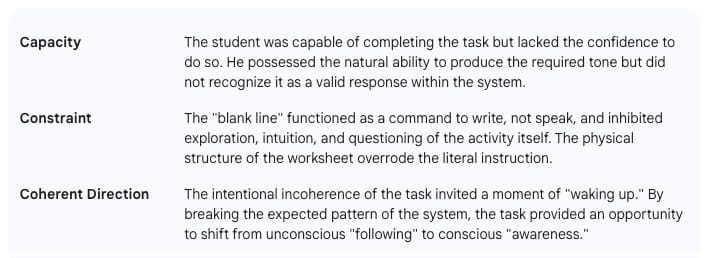
Capability, Constraint, Coherent Direction
Note that the word "participation" is used below in the sense of interaction between the system and the individuals within it.
The participant recognized the worksheet as a familiar type of language exercise: instructions followed by blank lines requiring written answers. A blank line in such an exercise does not merely provide space in which writing may occur. It functions as an instruction that signals: “write here.” The instruction asked for speech, but the established structure of a blank line signaling the need to write something overrode the sense that any other response might be possible or better. The learner followed the activity within the system familiar to him rather than explore the dissonance he felt.
Capacity
The participant possessed the ability that was required in order to respond to the instruction. This is clear because he produced a puzzled tone completely naturally — albeit unconsciously — while asking his question.
However, he did not imagine that the situation was inviting him to use that ability. In his system a blank line signals that a correct written answer is needed and speaking could not count as such an answer, he did not treat his own speech as completion of the task.
So, while he did not lack the capacity to act, he lacked these capacities:
- to see that the worksheet was an artifact that was inviting him to experience awareness of this moment;
- to be open to the possibility that questioning the system.
Constraint
The worksheet exercise illustrated clear participation rule of the prevailing system:
A blank line following an instruction signals the non-optional need to write a correct answer.
Th preceding items followed this pattern, reinforcing the invisible guidance leading the learner to treat the format as more authoritative than his own perception and consideration of the instruction.
This kind of constraint does more than guide action.
- It limits what is counted as a valid basis for action. Speaking was possible, but relying on one’s own judgment that this satisfied the task did not fit the rules of the activity. The learner therefore turned to the authority of the teacher, where correctness normally resides within the prevailing system.
- Crucially, another constraint that this story highlights is that the conditions of the system in which the learner is accustomed to operating clearly do not invite questioning and interactive participation with and within the system itself.
- A third constraint that the story implies is that the prevailing system does not encourage mistakes as part of the learning process. This is probably why the learner did not ask his question in front of everyone: the learner felt constrained to avoid his own embarrassment at making a mistake or that of the teacher — or perhaps both.
Coherent Direction
The artifacts of a system are microcosms of the system itself and the direction in which the people within the system are interactively participating and moving. A task or artifact is coherent when its signals support for the kind of participation the system expects. In this case, the learner came across an artifact that was not coherent— a worksheet task in this case.
The incoherence was used in this case as a deliberate technique that had the potential to trigger a feeling of "being alive or awake to the moment."
This discussion therefore challenges attitudes that might otherwise easily dismiss such words as lacking substance.
Summary
2026-02-15 This post is a living document. Over the coming weeks, I will be layering in links to the ACT framework and deeper dives into Interactive Participation. During February links to a number of thinking tool, keyword and other posts will be added here.